













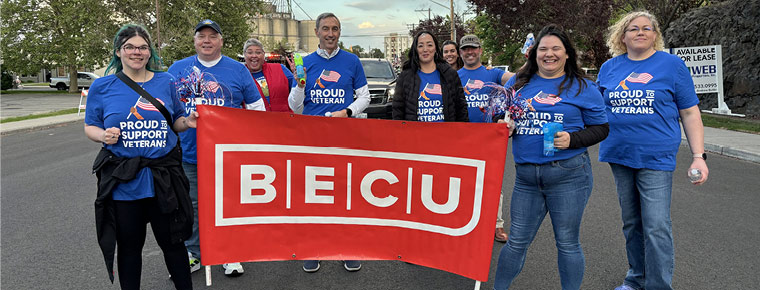
Military Veterans Reflect on Money Matters
BECU military veterans share the financial challenges and opportunities that come with serving.


U.S. military service members and their spouses face unique financial stressors and challenges.
A 2024 survey released by the National Foundation for Credit Counseling found that military households (service members and military spouses) are more likely than the general population to experience financial strain.
For example, service members are more than twice as likely to have missed credit card payments or three times as likely to transfer debt between cards. Service members are more likely than civilians to use nontraditional financial services such as payday loans, prepaid debit cards and cryptocurrency.
Military families also face frequent relocations, which can make financial planning, long-term ties to financial institutions and spousal employment difficult, according to an opinion piece in Federal News Network.
Veterans aren't spared the financial challenges of fraud attempts, either. A 2025 Federal Trade Commission report noted that a federal court halted a fraudulent debt-relief service that targeted veterans (among others) by impersonating banks and credit bureaus.
Three BECU employees share their financial observations about saving money, the GI Bill, personal and auto loans, VA home loans and more, drawn from service and experience, along with tips for fellow service members.
Budgeting and Saving
"When I think about the word 'budget,' I picture pie charts, spreadsheets, lots of decision making, and maybe some personal shame," said Bobby H., now BECU Manager, Systems Engineering.
"As a young Marine infantry assaultman who spent most of my active-duty tenure deployed in Okinawa, Japan, setting aside a formal budget was just not something I was excited about. The last thing I wanted to do was put a dollar amount to the large quantities of yakitori and teriyaki I was consuming."

However, Bobby wanted to save for some big expenses — including college — so he decided to develop a savings plan during his second deployment to Okinawa. He deposited a few hundred dollars from every paycheck into his savings account.
Once the money was out of sight and stored in savings, it was easier not to spend it.
"After a few months, I increased the amount I was putting in savings," he said. "It was just easier not to buy that super cool-looking third backpack that I didn't need."
"A somewhat humorous but practical tip for saving money while deployed: Get deployed somewhere without an ATM. It's hard to spend money you don't have access to."
Bobby left Marine service with over $20,000 in savings.
Avoiding Debt
Compared with the general population, service members are slightly more than twice as likely to use payday loans, and spouses use these high-rate loans four times as often.
Debt presents a particularly difficult problem for service members, who may be denied security clearances (PDF) in some situations due to debt, hampering their ability to advance their careers.
Numerous steps have been taken in the past 10 years to restrict lenders' attempts to prey on vulnerable service members. For example, the 2016 Military Lending Act provides rights to service members for credit products.
These rights include limiting the amount of interest to 36% and preventing prepayment penalties or waivers of consumer protections. The Military Lending Act also prevents any lender from requiring you to divert automatic payments from military paychecks (allotments) to get a loan.
However, some companies are still targeting military families. One CFPB analysis estimated that fewer than 6% of National Guard and Reserve members' loans received required rate reductions, leading to nearly $10 million in savings lost per year.
Younger people might instead look into secured loans or secured credit cards to build credit; good credit can help secure a lower auto loan interest rate in the future.
GI Bill and Education
After leaving active duty, Robin G. transitioned into the Army Reserve and took advantage of the GI Bill and Montgomery GI Bill to earn a college degree in computer science.
Robin entered the U.S. Army in 1979 as an active-duty enlisted soldier. As a petroleum, oils and lubricants specialist, she refueled helicopters, often in cold, remote corners of Germany. While on active duty, the responsibilities of the job can make schooling a logistical challenge, she said, although some people are able to juggle both.

Combining the two GI Bill programs provided Robin with substantial financial support for education, housing and books, with benefits available for college, vocational training, apprenticeships and other educational opportunities.
"Without those programs, I wouldn't have been able to afford school," she said. "They didn't just help me financially, but gave me purpose and opened doors I never thought possible."
As she moved into leadership roles, Robin ensured that every soldier was aware of their education benefits, including the GI Bill and programs such as Army Credentialing Assistance, which enabled them to earn certifications leading to civilian careers in fields like information technology, health care and logistics.
"I'd sit down with them, walk them through the paperwork, and share my own story," she said. "Education is one of the most powerful tools a soldier can carry."
Bobby also used the GI Bill to fund his education. He said it's important to keep in mind that the GI Bill isn't a blank check you get at the start of the school year, but a reimbursement after you've paid for tuition. The student is responsible for initial educational costs, and it's vital to save money for upfront costs and be prepared to pay back any loans.
"Engage early with your intended university's veteran student services office," Bobby recommended. "They educated me on qualifying for reduced tuition and ensured my GI Bill was approved before the initial school semester's start."
After 40 years in military service, Robin has seen firsthand how education can transform lives: "If you're wearing the uniform, or once did, don't leave these benefits on the table. Use them, share them and grow with them."
Robin certainly did so. Today, she acts as BECU's senior cybersecurity governance, risk, and compliance manager.
Moving from Military to Civilian Roles
Robin said those transitioning from the military into civilian careers can explore Army COOL (Credentialing Opportunities On-Line), which matches military experience with civilian job credentials.
Additionally, Transition Assistance Programs offer resume assistance, job search tools and interview preparation. MyCAA (Military Spouse Career Advancement Accounts) offers up to $4,000 for spouses pursuing portable careers.
"These programs aren't just for soldiers but all military personnel," she said. "Whether you're active duty, Reserve, National Guard or a veteran, these benefits can help you build a future beyond the military."
After retiring from the military in 2003, Marc W. benefited from the VA Vocational Rehabilitation program and earned a Bachelor of Science degree in finance. Marc W. joined the Marine Corps in 1995 and was an F-18 Aviation Maintenance Administrator in the Marine Corps and an Army Medic, stationed at Brooke Army Medical Center in San Antonio, Texas.
"I was fortunate to land a job with a military bank and insurance company, and they graciously paid for me to complete a Master of Business Administration degree," Marc said. That led to a retail and mortgage banking career for more than 19 years, and to BECU, where he works as branch manager at the Monroe Neighborhood Financial Center.

After a service member leaves, new financial management challenges can also arise. For example, service members with families lose the service-related pay that isn't taxed, such as subsidized housing and meals.
Decision-making felt challenging for Bobby after getting out of the military: "I wanted to get a nice used car and looked at a top-of-the-line Toyota 4Runner, which would have cost me around $18,000 at the time," he said.
He would have had to juggle the Toyota with first-semester college costs.
"I had to turn down the 4Runner and get an older used Subaru Outback for $6,000. The Outback, while not as sexy, got me through closed mountain passes, blizzards, and every type of weather Eastern Washington can throw at you," Bobby said. "It was an easy decision in the long run, but at the time, it was definitely a challenge to turn down a car I really wanted for the car I needed."
VA Loans
VA loans help veterans, service members and eligible surviving spouses buy homes using private banks and credit unions. The loans are unique for their low interest rates and limited closing costs. The VA doesn't require a down payment (although some lenders may), and yet there's no need for private mortgage insurance, no matter the size of your down payment.
"In my opinion, the VA loan is the greatest benefit offered to VA loan-eligible current and former military personnel," Marc said, after personally using VA loans eight times. In three instances, the loans were used for new construction.
More than 29 million homes have been purchased by veterans, service members and survivors with the help of VA loans. Nearly four million veterans have active VA-guaranteed home loans. The dollar figure the VA guarantees is called the loan entitlement, and can be up to 25% of a home loan.
"The VA website is the best resource, combined with a licensed mortgage loan officer specializing in VA loans," Marc said, if you're considering a VA loan. When interviewing potential real estate professionals to help you purchase a home, ensure they understand the VA loan process.
VA home loans are used to purchase a primary residence — but with a potential future twist.
"One little-known fact is that if you are looking for a new primary residence and have the entitlement available, you may turn the present property into an investment property," Marc said. "The key is to consider if you have adequate entitlement left to do so, you're purchasing a primary residence, and you can repay according to VA guidelines."
In addition, two VA-eligible borrowers can purchase a home together, using one entitlement, both, or splitting the entitlements as they see fit.
Yet veterans, like many Americans, sometimes struggle with the costs of home ownership. In 2024, the VA announced a new program to help more than 40,000 vets stay in their homes and avoid foreclosure.
This can help prevent future difficulties, as demonstrated by the VA's need to find permanent housing for more than 40,000 homeless veterans every year for the past two years.
Future Financial Education and Success
U.S. service members and veterans face distinct financial circumstances because of the nature of their work, and even basic financial education isn't taught to most of us, whether through families or school systems.
Those in the military can access resources to help alleviate common military-career issues and civilian challenges. Reaching out to knowledgeable individuals and resources can help.
Seek advice from the Department of Defense Office of Financial Readiness. There, personal finance counselors offer free financial consultations, retirement advice and help with navigating benefits, taxes, spending, credit and unique rights under the Military Lending Act.
The above article is intended to provide generalized financial information designed to educate a broad segment of the public; it does not give personalized financial, tax, investment, legal, or other business and professional advice. Before taking any action, you should always seek the assistance of a professional who knows your particular situation when making financial, legal, tax, investment, or any other business and professional decisions that affect you and/or your business.
Related Content

Money and Mental Health Self-Care Tips
Learn steps to improve your mental and financial health.


Banking Basics: Tips To Get Started
Learn how common banking accounts and services can help you manage your money.
Lora Shinn
Contributor